
Extremely Low Frequency (ELF) based Sensing and AI/ML-based Identification of Micro-UAS
This research engineered a fully integrated, passive detection system capable of identifying unmanned aerial vehicles (UAVs or Drones) through their characteristic ELF magnetic signatures generated by drone motors. The solution operates without active transmission, ensuring stealth and compliance with electromagnetic silence protocols in security-sensitive environments.
This work is Accepted for Publication at IEEE Sensors Journal (Q1) (Impact Factor-4.5) and preprint is available here.
Key Components and Methodology
Custom Antenna Design and Fabrication
Precision-wound search coil antennas were designed and fabricated to selectively capture magnetic field fluctuations in the 100 Hz–10 kHz band, corresponding to motor PWM switching and harmonic content. Multi-turn copper coils on high-permeability cores maximized sensitivity to microtesla-level emissions at standoff distances up to 15 meters.- Analog Frontend Signal Conditioning
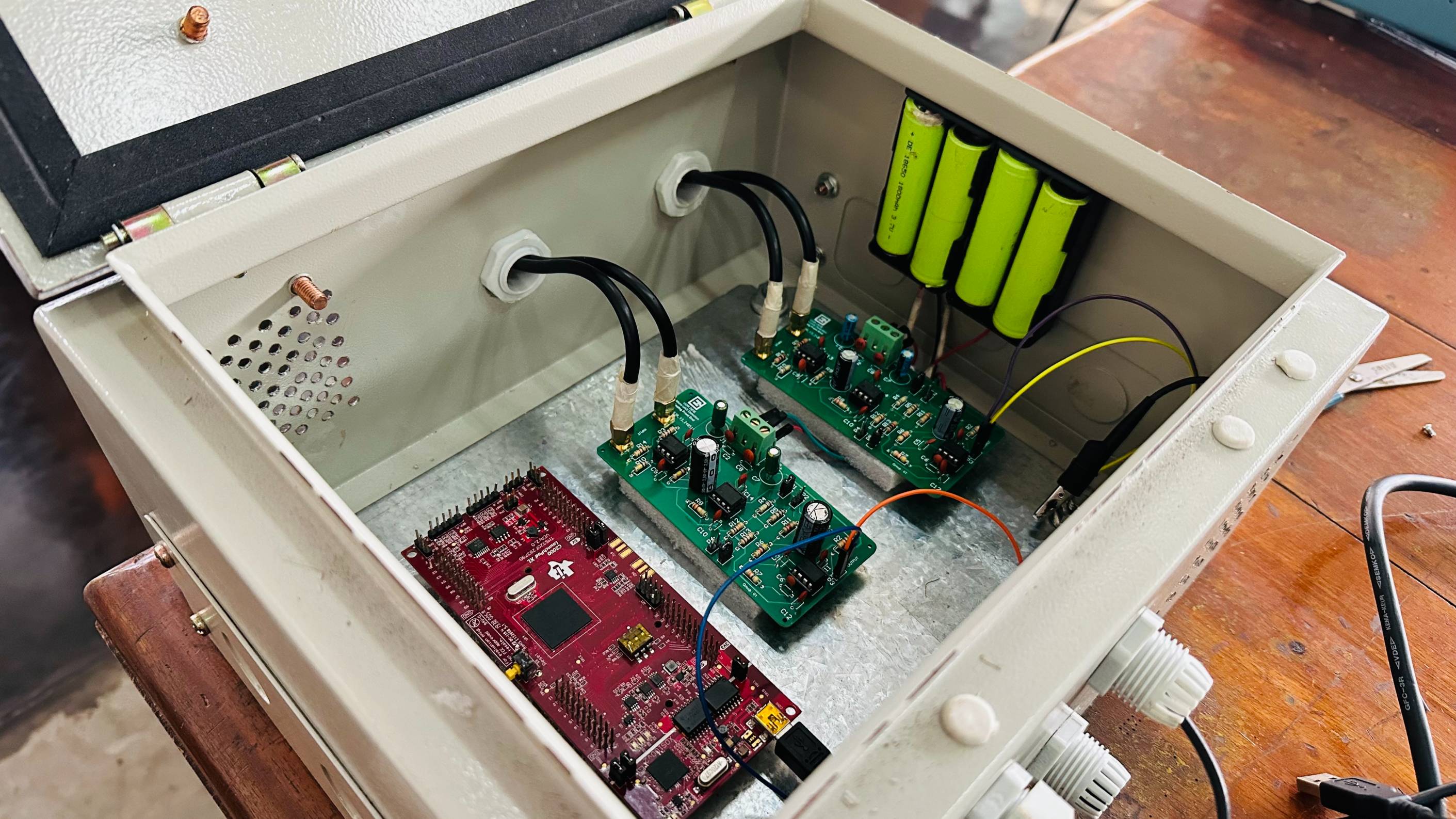
A high-gain, low-noise analog PCB was developed in Altium Designer, incorporating:- Multi-stage instrumentation amplification with programmable gain (10–1000×).
- 4th-order Butterworth low-pass filtering (cutoff tunable 1–20 kHz) for anti-aliasing and noise rejection.
- Active shielding and twisted-pair differential signaling to suppress common-mode interference.
The frontend achieved >80 dB SNR for target signals in urban electromagnetic clutter.
- Real-Time Digital Signal Processing
Embedded processing was implemented on the TMS320F28379D dual-core Delfino microcontroller using MATLAB Simulink for rapid prototyping and Code Composer Studio for deployment. The DSP pipeline included:- High-resolution ADC sampling at 100 kS/s.
- Frequency-domain transformation via FFT and Welch power spectral density estimation.
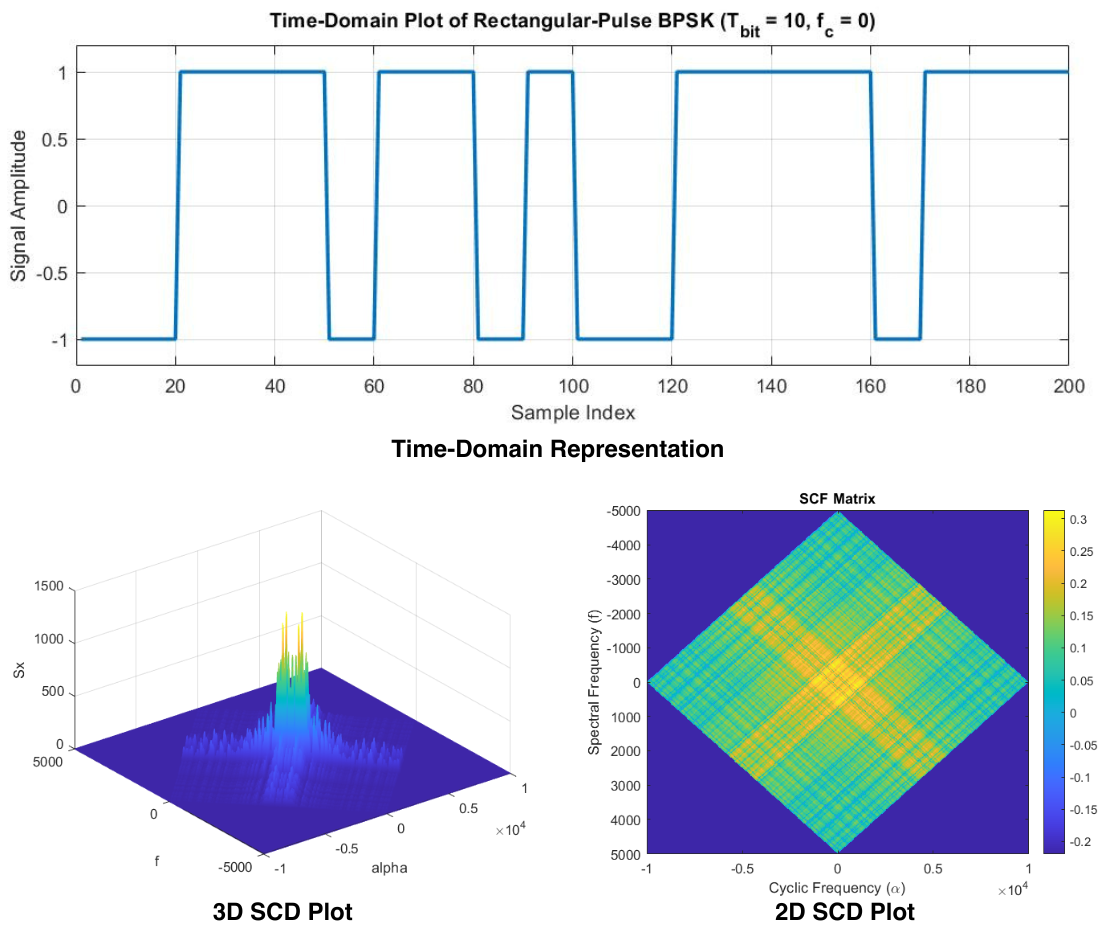
- Cyclostationary analysis to compute Spectral Correlation Density (SCD) functions, revealing periodic modulation invisible in conventional spectra.
SCD patterns served as robust, noise-resilient features for downstream classification.
- Machine Learning Classification Pipeline
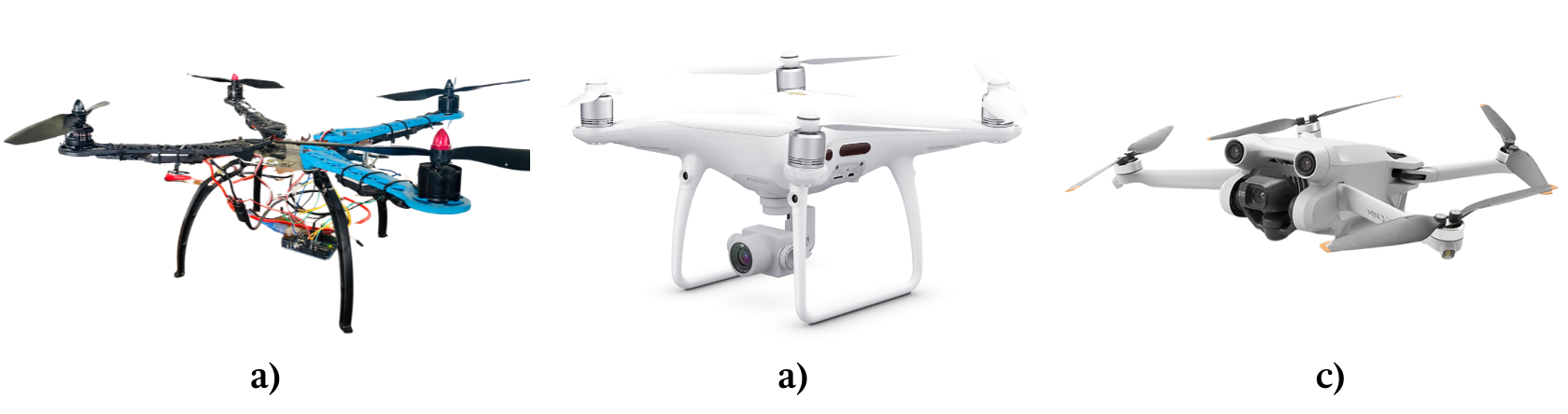
- Dataset Construction: ELF magnetic data collected from three drone platforms (custom faculty UAV, DJI Phantom 4 Pro, DJI Mini 3 Pro) under varied flight regimes (hover, ascent, translation). Negative class included ambient recordings and confounding sources (fans, vehicles).
- Preprocessing and Augmentation: SCD matrices rendered as 2D spectrograms; augmented via time/frequency shifting, Gaussian noise injection, and scaling to enhance generalization.
- Model Architecture: VGG16 backbone with transfer learning (ImageNet pretrained weights), fine-tuned via:
- Frozen convolutional base for feature extraction.
- Custom fully connected head with batch normalization, dropout (0.5), and ReLU activation.
- Binary (drone/no-drone) and 3-class (drone model) heads trained with categorical cross-entropy.
- Alternative Vision Transformer (ViT-B/16) explored for end-to-end sequence modeling of raw time-series segments.
Achieved >97% binary accuracy and >94% multi-class accuracy on hold-out test sets.
- System Integration and Real-Time Operation
DSP and ML inference were unified in a real-time embedded framework with a responsive GUI (PyQt-based). Detection latency <300 ms enabled proactive alerting. Field trials confirmed high specificity against environmental confounders (power lines, appliances).
Technical Contributions
- Designed and fabricated application-specific ELF magnetic sensors optimized for drone motor harmonics.
- Engineered a complete analog frontend in Altium Designer with multi-stage amplification and precision filtering.
- Implemented real-time cyclostationary processing and SCD computation on embedded hardware using MATLAB Simulink and CCS.
- Developed a comprehensive ML pipeline in Python/TensorFlow: data acquisition, SCD visualization, augmentation, and model optimization via transfer learning on VGG16 and Vision Transformers.
- Integrated full-stack system (hardware → DSP → ML → UI) for deployable, passive drone detection.
Visual Results

Additional Resources
Acknowledgments
This work was conducted as an independent research initiative with guidance from Dr. Chatura Seneviratne, Department of Electrical and Information Engineering, University of Ruhuna, Sri Lanka, Prof. Arjuna Madanayake, Florida International University USA, and PhD student Ms. Hiruni De Silva.